For years, 3D printing was largely associated with prototypes. Engineers could turn a digital model into a physical part without waiting for conventional tooling or machining, making additive manufacturing particularly valuable during product development.
That role is changing.
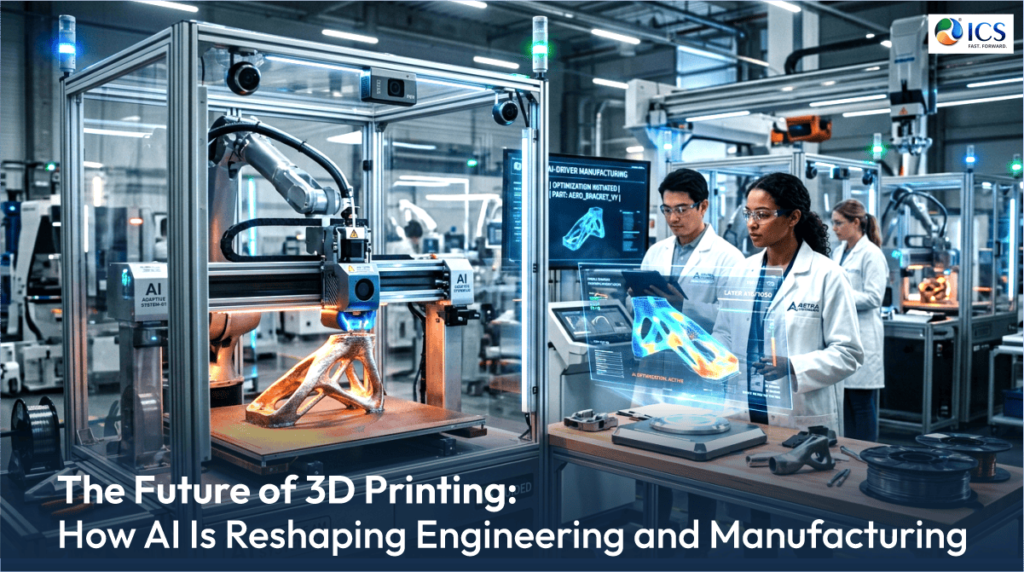
Today, 3D printing is moving deeper into engineering and production, while AI is making the entire process more intelligent. Generative design can explore shapes that traditional methods may overlook. Simulation can predict how a part will behave before it is printed. Machine learning can identify quality issues during production, while automation is making additive manufacturing more scalable. The result is a shift from simply printing parts to building a more intelligent digital-to-physical engineering workflow.
From Prototyping to Production
The biggest change in additive manufacturing is its expanding role beyond prototypes. Advances in printing technologies, materials, process control, and software are making 3D printing increasingly relevant for functional and production components.
For engineers, this creates opportunities to rethink how products are designed in the first place. Instead of designing a component around the limitations of conventional manufacturing and then adapting it for 3D printing, engineers can design specifically for additive manufacturing.
That opens the door to lightweight structures, internal channels, consolidated components, and geometries that would be difficult or impossible to produce using traditional methods. AI is taking this design freedom further.
AI Is Changing How Engineers Design for 3D Printing
One of the most promising intersections between AI and additive manufacturing is generative design. Engineers can define requirements such as load, material, weight, manufacturing constraints, and performance targets, allowing algorithms to explore multiple design possibilities.
Instead of asking, “How do we manufacture this existing design?”, engineers can begin asking, “What is the most efficient design for this function?” The difference is significant.
AI-assisted design can identify opportunities to reduce unnecessary material, improve structural performance, and optimize geometry. It can also evaluate numerous alternatives much faster than a conventional manual design process. For industries where weight, strength, thermal performance, or material efficiency matters, this can lead to entirely new approaches to product development.
Simulation Before the Printer Starts
A successful 3D-printed component depends on much more than the digital model. Material behavior, heat distribution, printing orientation, layer characteristics, and other process variables can influence the final result. Advanced simulation helps engineers understand these factors before committing to a physical build.
AI can enhance this process by analyzing previous simulation and production data to identify patterns and improve predictions. Instead of relying exclusively on repeated physical trials, engineering teams can evaluate more scenarios digitally and narrow down the most promising designs before production. This can shorten development cycles and reduce the material and time associated with trial and error.
Smarter Printing Through Real-Time Monitoring
Once production begins, AI has another important role to play.
Modern additive manufacturing systems can generate substantial amounts of data during the printing process. Sensors and monitoring systems can capture information about temperature, energy use, layer formation, machine behavior, and other process conditions.
AI can analyze these signals to detect anomalies that may indicate a developing quality issue.
Rather than discovering a defect after a component has been completed, manufacturers can potentially identify problems while the build is still underway. This creates an opportunity for earlier intervention and more consistent production quality.
For high-value components, where a failed print can represent significant material, machine time, and engineering effort, this capability can make a meaningful difference.
Reducing Material Waste
One of additive manufacturing’s biggest advantages is its ability to produce parts layer by layer, using material where it is needed rather than removing large amounts of material from a block. AI can build on this advantage.
By optimizing geometry, print orientation, support structures, and process parameters, intelligent systems can help reduce unnecessary material consumption. Engineers can also evaluate different designs based on their performance and resource requirements.
This makes AI-assisted additive manufacturing particularly relevant as manufacturers look for ways to improve sustainability without compromising performance. The goal is not simply to print faster. It is to use less material, less energy, and fewer resources to achieve the required result.
Automation Is Making Additive Manufacturing More Scalable
For 3D printing to move further into mainstream production, manufacturers need more than advanced printers. They need repeatable and scalable workflows.
Automation is helping connect design, simulation, production, inspection, and post-processing into a more continuous digital process. AI can support this workflow by helping prioritize production jobs, identify process anomalies, optimize machine parameters, and improve quality decisions. As these capabilities mature, additive manufacturing can become less dependent on manual intervention and more capable of supporting continuous production environments.
This is particularly important for industries dealing with customized components or lower-volume, high-value production where traditional tooling may not be economically practical.
What Comes Next?
The next phase of 3D printing is likely to be defined by deeper integration with AI, digital twins, robotics, advanced materials, and automated inspection. Digital twins could allow manufacturers to simulate both products and production processes before physical manufacturing begins. AI could continuously learn from real-world production data and feed those insights back into future designs. Robotics could automate handling and post-processing, creating increasingly autonomous manufacturing environments.
This convergence is turning additive manufacturing into part of a broader intelligent engineering ecosystem. For engineers, that means the value of 3D printing will increasingly lie not in the printer itself, but in the intelligence surrounding it.
Where Engineering Expertise Meets Intelligent Manufacturing
At ICS, we understand that emerging technologies deliver the greatest value when they are supported by sound engineering principles. The integration of AI, additive manufacturing, simulation, automation, and digital engineering requires more than adopting individual technologies. It requires understanding how they work together across the product lifecycle.
ICS supports organizations with engineering and design expertise that can help them explore smarter approaches to product development, manufacturing engineering, design optimization, and digital transformation.
By combining engineering knowledge with emerging technologies, ICS helps businesses evaluate new possibilities while keeping performance, manufacturability, efficiency, and scalability at the center of the process.
The Future Is More Than 3D Printed
3D printing is evolving from a tool for making prototypes into a critical part of modern engineering and manufacturing. AI is accelerating that evolution by making design, simulation, production, and quality control more intelligent.
The real opportunity lies in bringing these technologies together. When engineers can generate better designs, simulate them digitally, optimize the manufacturing process, and monitor production intelligently, the distance between an idea and a high-performance physical product becomes significantly shorter.
The future of additive manufacturing will not simply be about printing what we design. It will be about using AI and engineering intelligence to design, optimize, and produce what was previously difficult to imagine.
Partner with ICS to explore how advanced engineering, AI, and digital manufacturing technologies can help transform your next product or manufacturing initiative.