Building Information Modeling has changed the way engineering and construction teams approach design, coordination, and project information. Yet for many organizations, adopting BIM still feels easier on paper than in practice.
The challenge is no longer simply convincing teams to move from 2D drawings to digital models. Modern BIM adoption involves managing increasingly complex data, connecting different disciplines, developing new skills, and creating workflows that can support technologies such as artificial intelligence.
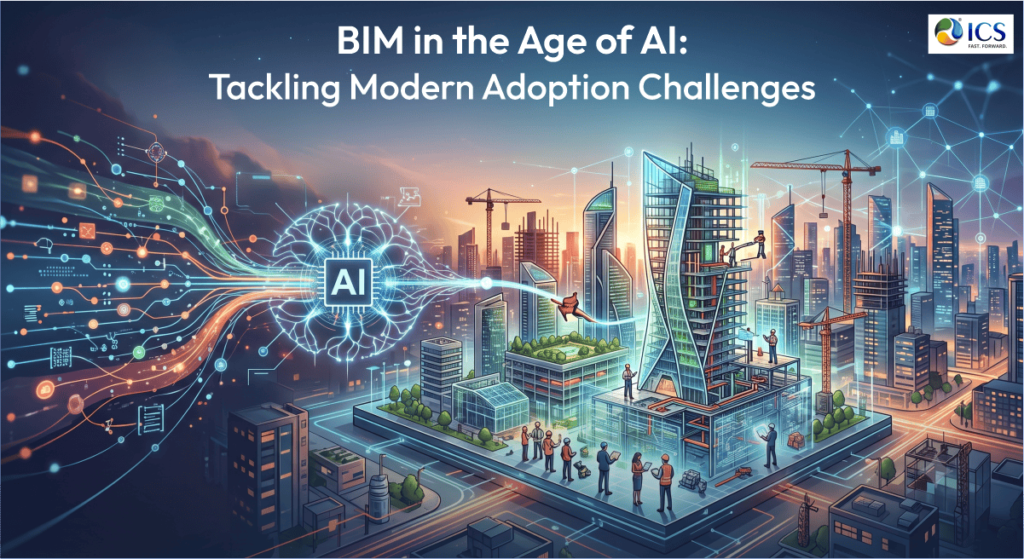
AI is adding another layer to this transformation. It can help automate repetitive tasks, analyze project information, identify potential issues, and support faster decision-making. But AI does not eliminate the fundamental challenges of BIM adoption. In many cases, it makes solving them more important.
BIM Adoption Is a Workflow Challenge, Not Just a Software Upgrade
One of the most common misconceptions about BIM is that implementation begins and ends with selecting the right software. Technology is only one part of the equation.
BIM changes how architects, engineers, contractors, project managers, and other stakeholders create, exchange, and use information. If every team follows different standards or maintains information in disconnected systems, even sophisticated BIM software can result in fragmented workflows.
Successful adoption therefore requires organizations to rethink how information moves through a project. Standards, responsibilities, naming conventions, model structures, collaboration processes, and data ownership all need to work together.
AI makes this even more relevant because intelligent systems depend heavily on the quality and structure of the information they analyze.
The Data Problem Behind the BIM Problem
A BIM model can contain enormous amounts of information. The difficulty is making that information consistent, accessible, and useful.
Different teams may use different formats, libraries, standards, or levels of detail. Older project data may exist in legacy systems, spreadsheets, PDFs, CAD files, or disconnected databases. Bringing this information together can become a significant implementation challenge. This is where AI can offer opportunities, but only when the underlying data is reliable.
AI can help classify information, identify patterns, extract data from documents, detect inconsistencies, and assist with model analysis. However, it cannot magically turn poorly structured project information into trustworthy intelligence. The lesson is straightforward: better AI outcomes begin with better BIM data.
Skills Are Changing Alongside the Technology
BIM adoption also creates a people challenge. Teams need more than the ability to operate BIM software. They need to understand information management, interdisciplinary coordination, model standards, data workflows, and increasingly, how AI-assisted tools fit into engineering processes.
This does not mean every engineer needs to become an AI specialist. Instead, organizations need to develop practical AI literacy alongside BIM expertise. Teams should understand where automation can add value, where human review remains essential, and how to validate AI-generated insights before using them in project decisions.
The most effective BIM environments are likely to be those where engineers work with AI rather than simply being asked to work around it.
From Clash Detection to Predictive Coordination
Traditional BIM workflows already provide major advantages in identifying clashes and coordinating disciplines. AI can take this capability further by analyzing larger volumes of project information and recognizing patterns that may be difficult to spot manually.
For example, AI-assisted systems can help analyze design changes, identify recurring coordination issues, compare project information, and highlight areas that may require additional attention.
The potential is significant, but organizations should avoid treating AI as an automatic replacement for engineering judgment. A clash detected by software still needs context. A predicted issue still needs validation. And an AI-generated recommendation still needs to be evaluated against project requirements, engineering standards, and real-world conditions.
The goal is not to remove engineers from the workflow. It is to give them better information earlier.
The Resistance to Change Is Often More Complex Than It Looks
Technology adoption can fail even when the technology itself works well. Teams may resist BIM because existing processes are familiar. Project deadlines can make new workflows feel like an additional burden. Management may expect immediate returns while employees are still learning. Different stakeholders may also have different expectations about what BIM should deliver.
Adding AI to the conversation can make this more complicated. Organizations should therefore avoid trying to transform everything at once. A phased approach can make adoption more practical. Start with specific processes where BIM and AI can address measurable problems, establish standards, train teams, evaluate results, and then expand.
This creates a transformation based on actual project needs rather than technology for technology’s sake.
Building BIM for the Entire Asset Lifecycle
Another important shift is moving beyond BIM as a design-stage tool. The information created during design can continue to support construction, operations, maintenance, asset management, and future modifications. AI can potentially add value across these stages by analyzing historical information, supporting predictive maintenance, identifying patterns in asset performance, and helping teams retrieve relevant information faster.
That requires organizations to think about BIM as an information environment rather than simply a model.
The question becomes less about “Can we create a BIM model?” and more about “Can we create information that remains useful throughout the asset lifecycle?”
How ICS Supports Smarter BIM Adoption
At ICS, BIM is approached as part of a broader digital engineering workflow.
Our BIM and CAD capabilities can support organizations in creating structured, coordinated digital models while connecting engineering information with the processes that depend on it. By bringing engineering expertise together with evolving AI capabilities, ICS helps organizations explore more intelligent approaches to design coordination, data management, and project workflows. The objective is practical: make digital engineering information easier to use, easier to coordinate, and more valuable throughout the project lifecycle.
The Future of BIM Is More Intelligent, Not Simply More Digital
BIM adoption is entering a new phase. The challenge is no longer just moving engineering information into digital models. It is about making that information connected, usable, and increasingly intelligent. AI can help accelerate that shift, but successful implementation still depends on strong data, capable teams, clear processes, and sound engineering judgment.
Organizations that get those foundations right will be better positioned to move from BIM as a modeling technology toward BIM as a foundation for smarter engineering decisions.
Want to take your BIM workflows further? Explore ICS BIM and digital engineering services to build more connected, intelligent project workflows.