Renewable energy infrastructure is changing the way power is generated and distributed. Solar farms are expanding across large areas, wind turbines are reaching greater heights, and battery storage systems are becoming an increasingly important part of modern energy networks. As these installations grow in scale, so does their exposure to environmental risks.
Lightning is one of those risks that can be difficult to predict and expensive to ignore.
A single lightning event can damage electrical and electronic equipment, disrupt generation, trigger protection-system failures, and create extended downtime. For renewable energy installations, where large numbers of interconnected components can be spread across considerable distances, understanding and managing lightning risk is becoming increasingly important.
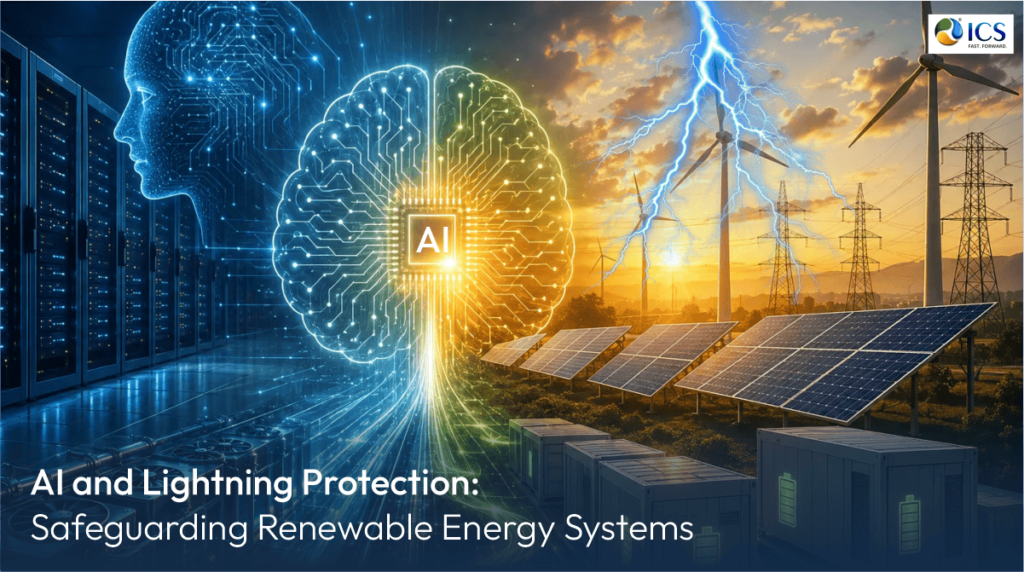
Artificial Intelligence is adding a new dimension to that challenge. AI cannot prevent lightning from occurring, but it can help engineers understand lightning risk more effectively, analyze large volumes of environmental data, and support more informed protection strategies.
Why Renewable Energy Installations Face Unique Lightning Risks
Solar and wind installations do not present the same physical profile as conventional power infrastructure.
A utility-scale solar farm may cover hundreds of acres, with panels, inverters, transformers, monitoring equipment, and electrical connections distributed across a large site. Wind turbines, meanwhile, extend hundreds of feet into the air, placing blades, nacelles, generators, and control systems directly in the path of atmospheric electrical activity.
The increasing use of sensitive electronic equipment adds another layer of vulnerability. Even when a lightning strike does not cause direct physical damage, associated surges and electromagnetic effects can affect controls, communication systems, inverters, and other critical components.
This makes lightning protection an important consideration from the earliest stages of renewable energy project design.
AI Is Changing How Lightning Risk Is Understood
Lightning protection has traditionally relied on established engineering standards, site characteristics, historical lightning activity, and calculations performed during the design process. These remain essential.
AI can complement these approaches by processing significantly larger datasets and identifying relationships that may be difficult to evaluate manually.
Machine learning systems can analyze information such as historical lightning activity, weather patterns, geographic conditions, atmospheric data, and site-specific characteristics. Over time, these models can help identify patterns associated with elevated lightning risk.
For renewable energy developers, this creates an opportunity to move toward more data-driven risk assessment rather than relying exclusively on generalized historical assumptions.
From Historical Data to Predictive Insight
One of the most interesting applications of AI is its ability to work with real-time and historical data simultaneously.
Weather systems, lightning detection networks, satellite observations, and other monitoring technologies continuously generate information about atmospheric conditions. AI can process this information to identify changing risk patterns and provide predictive insights.
For example, an intelligent monitoring system could identify conditions associated with increased lightning activity around a renewable energy facility and support decisions related to operational readiness or equipment protection.
The objective is not to replace established lightning protection systems. Instead, AI provides another layer of intelligence that can help operators understand when and where risks may increase.
Protecting Distributed Solar Infrastructure
Solar farms present a particular challenge because of their scale. A single facility may contain thousands of interconnected panels and extensive electrical infrastructure.
A lightning protection strategy therefore needs to consider the entire installation rather than treating individual components in isolation.
AI-supported spatial analysis can help engineers evaluate site characteristics and identify areas that may require greater attention. When combined with GIS and digital engineering models, data can be visualized across the facility to support more informed planning.
This can be particularly valuable when assessing equipment locations, grounding requirements, protection zones, and potential exposure across a large site.
Safeguarding Wind Energy Systems
Wind turbines present a different challenge. Their height and physical design make them particularly exposed to lightning strikes.
Modern turbines incorporate lightning protection systems designed to capture and safely conduct lightning current through the structure. However, ongoing monitoring and analysis can provide additional insights into system performance.
AI can help analyze turbine operating data, environmental conditions, maintenance records, and historical lightning events to identify patterns that may indicate elevated risk or equipment degradation.
This could support condition-based maintenance strategies, helping operators investigate potential problems before they result in significant equipment damage or downtime.
AI and Predictive Maintenance
Lightning protection does not end once a system has been installed. Protection components, grounding systems, surge protection devices, and associated infrastructure need to remain effective throughout the asset lifecycle.
This is where AI-powered predictive maintenance can become valuable.
By combining inspection records, sensor data, maintenance history, environmental information, and equipment performance data, AI can help identify assets that may require inspection or maintenance.
Instead of applying identical maintenance schedules across an entire renewable energy site, operators can potentially prioritize resources according to actual risk and condition.
Designing for a More Resilient Energy Future
As renewable energy becomes a larger part of the global power infrastructure, resilience will become increasingly important. Solar farms, wind farms, battery storage facilities, and hybrid energy installations must be capable of operating safely under changing environmental conditions.
AI can contribute to this resilience by connecting environmental intelligence with engineering decisions.
However, technology alone cannot provide adequate lightning protection. AI-generated insights must ultimately be interpreted within established engineering practices, applicable standards, site-specific conditions, and professionally designed protection systems.
The strongest approach combines advanced analytics with proven engineering principles.
How ICS Supports Lightning Protection Design
At ICS, we recognize that renewable energy infrastructure requires lightning protection strategies designed around the specific characteristics of each installation. Our Lightning Protection Design (LPD) services support projects through detailed engineering analysis and protection planning.
ICS can help organizations address lightning risks across complex infrastructure by applying engineering expertise to the design of appropriate protection systems, grounding strategies, and related solutions. As AI, geospatial technologies, digital modeling, and predictive analytics continue to evolve, these capabilities can further enhance how lightning risk is assessed and managed.
For renewable energy developers and infrastructure owners, this combination of engineering knowledge and emerging technology provides a stronger foundation for protecting critical assets.
Building Safer Renewable Energy Systems
The transition to renewable energy is creating infrastructure that is larger, more distributed, and increasingly dependent on sensitive electrical and digital systems. Lightning protection must evolve alongside it.
AI offers an opportunity to make that evolution smarter by turning vast amounts of environmental and operational data into actionable insights. When combined with sound engineering practices, intelligent monitoring, and robust protection design, it can help renewable energy operators better understand risk and strengthen infrastructure resilience.
Looking to strengthen lightning protection for your renewable energy installation? Connect with ICS to explore our Lightning Protection Design services.