When the IT team is constantly putting out fires, who is looking after the bigger picture?
For many businesses, technology has become essential to almost every operation. Employees depend on reliable systems to communicate, access information, serve customers, and complete everyday tasks. Yet behind the scenes, internal IT teams are often stretched thin, balancing support requests, security concerns, system maintenance, upgrades, and long-term technology planning.
The result is familiar: growing backlogs, delayed projects, recurring technical issues, and teams that spend more time fixing problems than preventing them.
Hiring additional IT staff may seem like the obvious answer, but it is not always practical or cost-effective. This is where co-managed IT comes in. By combining an organization’s internal IT capabilities with the expertise of an external technology partner, businesses can build a more flexible support structure, improve productivity, and reduce pressure on their teams.
What Exactly Is Co-Managed IT?
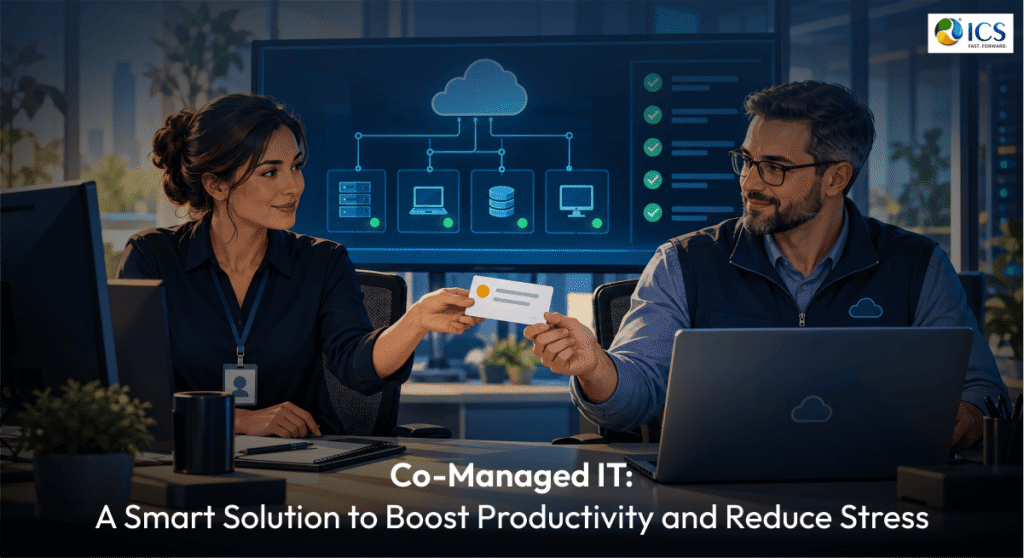
Co-managed IT is a collaborative approach in which an external IT service provider works alongside an organization’s existing IT department.
Unlike fully outsourced IT, where an external provider takes over most or all technology responsibilities, co-managed IT allows businesses to retain control of their internal IT operations while bringing in additional expertise and resources where needed.
The arrangement can be tailored to the organization’s requirements. An external partner might handle cybersecurity monitoring, infrastructure management, cloud administration, help desk support, backup management, or specialized technology projects.
The internal team continues managing business-specific systems and priorities, while the external partner fills capability gaps and takes responsibility for agreed areas of support.
Think of it as extending your IT department without having to build an entirely new one.
1. Reduce the Pressure on Internal IT Teams
One of the biggest advantages of co-managed IT is that it helps distribute the workload.
Internal IT professionals frequently handle everything from password resets and software issues to network troubleshooting and security incidents. When routine support requests consume most of their working hours, strategic initiatives often get pushed aside.
A co-managed arrangement allows an external partner to take on selected responsibilities, such as monitoring systems, resolving routine support tickets, or managing infrastructure maintenance.
This gives internal teams more time to focus on business-critical projects, technology improvements, and employee requirements.
It also reduces the pressure of being the only point of contact for every technical issue.
2. Access Expertise Without Expanding Headcount
Technology environments are becoming increasingly complex. Businesses need capabilities across cloud platforms, cybersecurity, networking, data protection, infrastructure, and application management.
Maintaining all these skills within a small internal team can be difficult. Recruiting specialists for every requirement may also increase operational costs.
Co-managed IT provides access to a wider pool of technical expertise without requiring businesses to hire full-time employees for every specialized role.
For example, an organization may have an internal IT administrator who understands its systems well but needs additional cybersecurity expertise. An external partner can provide security monitoring, threat analysis, and incident response support while the internal administrator continues managing everyday operations.
The business gets access to complementary skills without losing the knowledge and continuity of its existing team.
3. Improve Productivity Through Proactive IT Management
Repeated technical problems have a way of affecting everyone.
A slow network, unreliable application, recurring system outage, or poorly managed software update can interrupt work across multiple departments. Employees lose time, support requests pile up, and internal IT teams are forced into reactive mode.
Co-managed IT introduces more structured monitoring and maintenance practices. External specialists can monitor infrastructure, identify unusual activity, review system performance, and address potential issues before they become major disruptions.
Automation can further support these activities through routine patch management, alerts, backup checks, and system monitoring.
The objective is to spend less time responding to preventable problems and more time keeping technology dependable for the people who use it.
4. Strengthen Cybersecurity and Reduce Risk
Cybersecurity is no longer a responsibility that can be handled occasionally or treated as a separate IT activity. Businesses face evolving threats, including phishing, ransomware, compromised credentials, and unauthorized access.
For smaller IT departments, keeping up with security monitoring, vulnerability management, access controls, and incident response can be challenging.
A co-managed IT provider can bring additional security capabilities to the organization. Depending on the service arrangement, this may include endpoint monitoring, security updates, threat detection, vulnerability assessments, backup management, and incident response planning.
External expertise also helps internal teams review existing security practices and identify areas that need improvement.
While no service arrangement can eliminate every cyber risk, a coordinated approach can improve visibility and strengthen an organization’s ability to respond.
5. Scale IT Support as Business Needs Change
IT requirements rarely remain the same for long. A business may introduce new applications, expand into additional locations, move workloads to the cloud, or experience a sudden increase in users.
An internal team that was sufficient a year ago may struggle to support these changes.
Co-managed IT offers flexibility. Businesses can adjust the level of external support according to their workload, technical requirements, and growth plans.
This makes it easier to handle technology projects, support expansion, and access specialist resources when required without permanently increasing internal staffing levels.
6. Build a Partnership, Not Another Support Queue
The success of co-managed IT depends on how well the internal team and external provider work together.
Responsibilities should be clearly defined. Both sides need visibility into systems, agreed escalation procedures, shared documentation, and regular communication. Without these foundations, businesses risk creating overlapping responsibilities and confusion rather than improving support.
A good co-managed IT partner works as an extension of the internal department. It understands business priorities, communicates clearly, and aligns technology support with the organization’s operational goals.
How ICS Supports Smarter IT Management
At ICS, Managed IT Services are designed to help businesses maintain reliable technology environments while addressing their evolving IT requirements.
Through infrastructure support, proactive monitoring, cybersecurity, and ongoing IT management, ICS helps organizations strengthen their technology operations and reduce the burden on internal resources.
Whether a business needs additional technical expertise, more structured IT support, or assistance managing its technology environment, the right service approach can make a meaningful difference.
Give Your IT Team Room to Do More
Your internal IT team should not have to choose between keeping daily operations running and preparing the business for what comes next.
Co-managed IT offers a practical way to balance both. By combining internal knowledge with external expertise, businesses can reduce operational pressure, improve technology reliability, and give their teams more room to focus on meaningful work.
Less firefighting. Better support. More room to grow.
Explore ICS Managed IT Services and discover a smarter way to support your business technology. Talk to us today!